

Which of these statements is true? Location targeting determines which business address appears in an extensionLocation extensions appear when someone who’s physically near the business searches on relevant termsLocation targeting enables location extensionsLocation extensions appear when an advertiser targets a ...
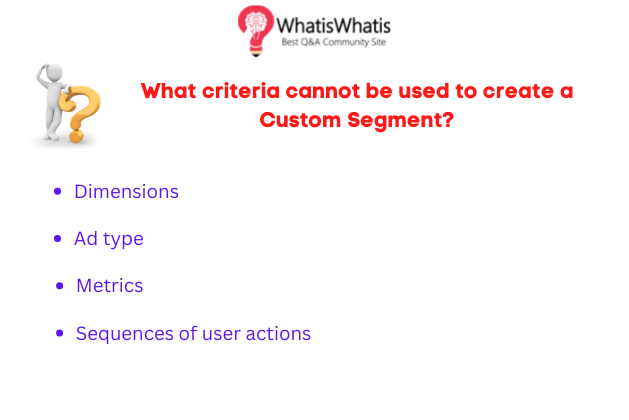
The correct answer for the above question is: Ad type Here you can read the explanation about the Segments: https://support.google.com/analytics/answer/3124493 When creating a Custom Segment in analytics platforms like Google Analytics, it’s essential to know what criteria can and cannot be used. NoRead more
The correct answer for the above question is:
- Ad type
Here you can read the explanation about the Segments: https://support.google.com/analytics/answer/3124493

When creating a Custom Segment in analytics platforms like Google Analytics, it’s essential to know what criteria can and cannot be used. Notably, Ad type is the criteria that cannot be utilized when crafting a Custom Segment. Custom Segments allow you to filter and analyze subsets of users based on specific dimensions, metrics, or sequences of user actions. However, Ad type is not a valid criterion for this purpose, making it an outlier compared to other customizable options.
Understanding these limitations helps ensure that you’re using the most effective strategies for segmenting and analyzing your data.
See less
The correct answer for the above question is: Location extensions appear when someone who’s physically near the business searches on relevant terms Here you can read the explanation about the Location Extensions: https://support.google.com/google-ads/answer/2404182?hl=en
The correct answer for the above question is:
Here you can read the explanation about the Location Extensions: https://support.google.com/google-ads/answer/2404182?hl=en
See less